


The Role of Project Scheduling in Ensuring La
14 October, 2026"স্বপ্নের বাড়ি, আমরা গড়ি"
"স্বপ্নের বাড়ি, আমরা গড়ি"
 21 April, 2026 |
  by Admin
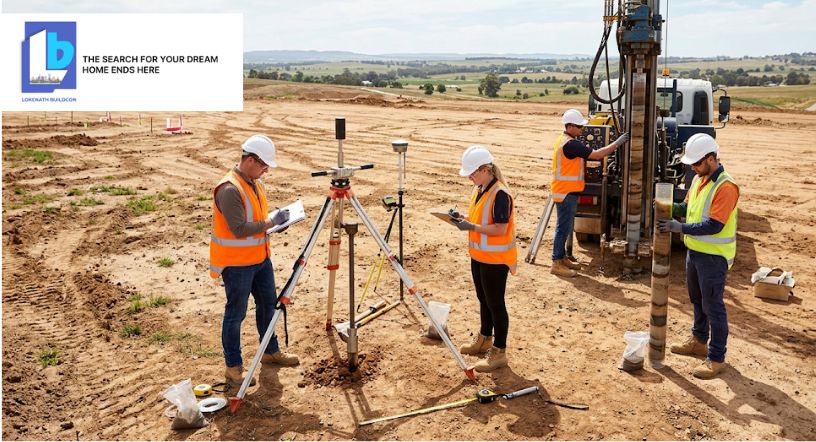
When planning any construction project, whether it’s a residential home, commercial complex, or industrial facility, the focus often lies on design, materials, and budget. However, one critical step that determines the long-term success of any structure is often overlooked: soil testing. Understanding the condition and capacity of the soil beneath your project is not just a technical formality; it is the very foundation of safe and sustainable construction. Therefore, in this blog, we will discuss why soil testing is the foundation of safe construction. If you’re searching for a reliable real estate builder in Kolkata, knowing the importance of soil testing can naturally guide you toward safer and more reliable choices.
Soil testing before construction is a scientific process used to assess the physical and chemical properties of soil. It determines factors such as soil type, bearing capacity, moisture content, compaction level, and the presence of contaminants. These insights help engineers design foundations that are stable, durable, and suited to the specific ground conditions.
Ignoring soil testing can lead to severe consequences, including structural instability, uneven settlement, cracks in walls, and even complete building failure. Simply put, no matter how strong your construction materials are, a weak or unsuitable foundation can compromise the entire structure.
Understanding the ground beneath your project is not just a technical step; it’s a strategic advantage. Here’s why soil testing plays a vital role and deserves serious consideration in every construction project.
One of the most important aspects of soil testing is that it ensures the structural stability of a construction. Soil testing reveals whether the land can safely support the intended load of the structure. With accurate data, engineers can choose the most suitable foundation type, shallow or deep, ensuring the building remains stable and free from issues like sinking, shifting, or tilting over time.
Do you know that hidden soil issues can turn into major financial burdens if left undetected? Early soil analysis, therefore, helps identify potential risks, allowing builders to implement corrective measures in advance and avoid the high costs of future repairs and maintenance.
We are all aware that building on unstable or contaminated soil can lead to serious structural hazards. In such a context, soil testing ensures that the site meets safety regulations, minimizing risks to both construction workers and future occupants while enhancing overall project reliability.
Another very significant advantage of soil testing is its ability to help in proper drainage planning. Soil characteristics directly affect how water is absorbed and drained. Testing helps design efficient drainage systems, reducing the risk of waterlogging, soil erosion, and long-term damage to the foundation.
What enables builders to create more eco-conscious structures? A deep insight into soil composition helps limit unnecessary digging, improve material efficiency, and ensure sustainable construction with minimal environmental harm.
Before any structure rises above the ground, experts first unlock the hidden story beneath it. Engineers apply a combination of advanced soil testing methods to decode soil behavior with precision. They use the Standard Penetration Test (SPT) to measure resistance and density, revealing the soil’s strength and compactness, while the Plate Load Test determines how much load the ground can safely bear. In laboratories, specialists further analyze soil samples to assess moisture levels, plasticity, and chemical composition. By integrating these methods, experts build a clear, reliable understanding of the soil profile, enabling smarter and safer construction decisions.
Failing to conduct soil testing can result in uneven settlement, foundation cracks, water seepage, and structural damage. In extreme cases, it can even cause building collapse, posing risks to life and property. Additionally, legal complications and financial losses can also arise if construction does not meet safety standards.
Soil testing should be conducted at the very beginning of the project, even before finalizing the design. Early testing can allow architects and engineers to adapt sustainable construction plans according to ground conditions, ensuring efficiency and safety from the start.
Construction success doesn’t begin with bricks or blueprints. A building’s true strength always begins with understanding the ground that holds it all together. Soil testing is the silent safeguard that can transform uncertainty into confidence, ensuring every structure stands strong for years to come. At Lokenath Buildcon, we conduct comprehensive soil testing before starting every project to ensure strength, safety, and long-term durability. Contact us today to own a safe, secure, and future-ready home built on a truly reliable foundation.
The Role of Project Scheduling in Ensuring La
14 October, 2026
Essential Tips for Evaluating Balcony Space W
07 October, 2026
What is Driving Investors to Commercial Prope
28 September, 2026
Considerations about Buying or Leasing an Off
21 September, 2026
How IoT Transforms an Ordinary Home into a Lu
14 September, 2026
Why Look for a Smart Door Lock before Buying
07 September, 2026
What Makes 1 BHK Apartments Trendy among Youn
28 August, 2026
Do 3 BHK Apartments Offer Higher ROI?
21 August, 2026
Is Your Apartment Monsoon Ready? Consider a F
14 August, 2026
Why Go with Redevelopment for Designing an Ol
07 August, 2026


Enquire Now
 Call
Call WhatsApp